Sample Parent Week 1 – Y2:M9:W1

TOPIC
Wellbeing Strategies

FOCUS
Mindfulness

SUBJECT
Deep Breathing
CORE MH Curriculum in School
The home task below is a repeat of the one in school as it contains some very useful exercises for children to practise deep breathing exercises when their emotions feel ‘too much’. Hopefully, if these exercises are demonstrated at school and home they will be memorable and normalised as ways to cope with big feelings.
Home Tasks
Discussion and activity tasks to do at home to support the learning from school.
Discussion:
- To help your child become more self-aware, encourage mindfulness, and get them curious about their body’s signals, please ask them some of these questions about breathing:
- “How does your body feel when you take a big, deep breath?”
- “Do you like to breathe through your nose or your mouth, or both?”
- “When you’re feeling calm, how does your breathing feel?”
- “Can you show me how you breathe when you’re excited? How about when you’re sleepy?”
- “What helps you feel calm? Does breathing slowly help?”
- “If your breath had a colour, what colour would it be when you’re calm? What about when you’re worried?”
- “Do you think it’s easier to breathe slowly sitting down, lying down, or standing up?”
- “Can you feel your tummy move when you take a big breath? Or does your chest move more?”
- Please watch the video below to find out more about the breathing exercises or follow the instructions with the task:
Activity: Breathing Exercises
Here are a selection of child-friendly ways of deep, conscious breathing by Savina et al, (2021: 149):
Encourage children to choose ONE or more that resonates with them and practise it and model it yourself if possible…
This task involves imagination, but if you would like to use objects (a balloon, flower, candle etc) to help your child imagine please do…
1) Balloon: 🎈
Picture their bellies filling up like a balloon as they breathe in.
2) Flower: 🌸
Breathe in as if they are smelling a flower.
4) Candles:🕯️
Imagine that they are blowing out birthday candles.
4) Ball:🏀
Imagine they are trying to roll a ball across the table with their breath.
5) Hot Chocolate: ☕
Pretend to be holding a cup of hot chocolate and take a deep smell on the inhale and then slowly and gently blow on it to cool it off on the exhale.
6) Pinwheel: 🎡
Pretend, or use a pinwheel (if you have some?) to blow on and watch it turn with their out breath.
7) Bird: 🦜
Pretend to be a bird flapping its wings and as you breathe in lift your arms (wings) up and then drop them down on the out-breath.
8) Bubbles: 🫧
Blowing bubbles is also a nice way to encourage a focus on the out breath.
9) GIF:
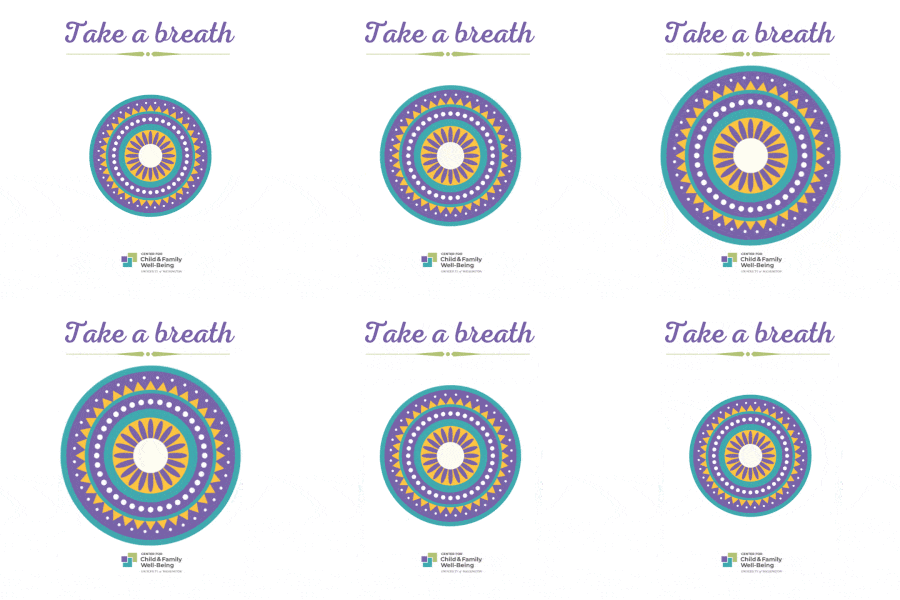
Breath to a GIF (an image that grows) as they breathe using this website: Animated Images to Inspire Deeper Breathing – The Center for Child and Family Well-Being
Don’t forget to think of a balloon to fill your lower tummy with air when you breathe!
- Explain that when feelings get big, our breath is always there to help us calm down.
- Here are 5 short questions you can ask your child after practising breathing exercises, with quick activities to make each question more memorable. I have also included a typical answer that a child might have to each question…
- 1. How does your body feel before and after you take slow breaths?
👉 Activity: Put one hand on your chest and one on your tummy. Take 3 slow breaths together and notice the difference.
💬 Example child response: “Before my heart was going really fast, now it feels slower.”
2. What kind of feelings do you think breathing can help with?
👉 Activity: Say some feelings (angry, worried, excited). Your child gives a thumbs up if breathing would help, or thumbs down if not.
💬 Example child response: “It helps when I’m worried about school but not really when I’m sleepy.”
3. If your feelings were like waves in the sea, how does your breathing help you with those waves?
👉 Activity: Pretend to be waves and lift arms high for a “big wave” and slowly lower them while breathing out. Try smaller waves to show how breathing calms them down.
💬 Example child response: “It makes the waves smaller, like they’re not so splashy anymore.”
4. When do you think would be a good time to try a few breaths—at home, at school, or somewhere else?
👉 Activity: Role play being nervous before a school question or worried at bedtime. Take 3 breaths together to show how it helps. Swap roles.
💬 Example child response: “Before I go into class or when I have to read in front of people.”
✨ Tip : These short chats and activities work best when you keep them playful and positive. The goal is not to “fix” big feelings but to help your child remember they have a calming tool they can always use.