Welcome to CORE mental health...
Supporting children’s mental health in Primary Schools and within families via a PSHE/RSHE Curriculum (with mental health at its CORE) and Home Wellbeing Programme for 4-11 year olds.
Children need good mental health and wellbeing to thrive & learn!
CORE Mental Health provides fun, affordable, early intervention sessions that are easy to deliver, practical and evidence-based.
Updated to 2026 statutory RSHE requirements and Ofsted-ready assessments.
core mental health
revolutionising mental health support in primary schools and homes by Creating a Joined up approach
A week-by-week curriculum and Home Wellbeing Programme to strengthen children's mental health
Empowering teachers to confidently address Personal, Social, Health and Economic (PSHE) and Relationships, Sex and Health Education (RSHE) topics to reduce mental health stigma and create a more compassionate whole-school environment.
Informing parents/carers about what is being taught in school each week; also providing a consistent approach where they engage with the same aligned topics each week at home with their child in a fun, engaging way with videos, audio notes and interactive tasks.
School year
Reception - y6 Ages 4 to 11
Mental Health and Wellbeing, PSHE & RSHE
Evidence Based
Online
English
Impact
Ofsted feedback:
“The curriculum is well-sequenced and adapted to meet pupils’ needs and their locality. Pupils speak with maturity and in detail about keeping themselves safe, as well as about different types of families and relationships” (Burford CE Academy, June 2026).
The Curriculum and Programme
discover our range of topics designed to build resilience
benefits of the core MH curriculum
effectively build lifelong mental wellbeing in children.
‘Schools afford a great opportunity…to promote overall emotional wellbeing and social and moral development. Schools are imperative in mental health promotion and prevention.’
The Centre for Mental Health Missed Opportunities Report 2016
- Early intervention
- Whole-school approach
- Proactive approach
- Build emotional literacy and resilience
What Does CORE stand for?
Child-centred
Appeals to young children and even introverted pupils.
Collaborative
Teachers work alongside children in sessions.
Compassionate
The approach prioritises kindness & understanding.
Creative
There’s a focus on PLAY and imagination to engage children, making mental health learning both fun and impactful.
Open
Uses open & honest language to normalise discussions about mental health and reduce stigma. Children are encouraged to authentically express their feelings knowing all feelings are okay.
Relationships
Relationships are key to a child receiving effective support. The aim of CORE MH is to foster trust & connection between children, teachers, families and the wider school community.
Resilience
Aimed at building resilience which is paramount in supporting a child’s mental health.
Environment
Focuses on building a safe and supportive environment.
Empathy
Empathy is a central value of the curriculum and programme as children are encouraged to understand and respect each other’s feelings and perspectives.
Emotional Regulation
Emotional regulation strategies weave through CORE MH with activities that help children manage their emotions effectively and independently.
An Introduction
What is the Curriculum and Home Wellbeing Programme about?
Who We Are
find out more about the story behind CORE Mental Health
topics
What topics are covered in the CORE MH curriculum and Home Wellbeing Programme?
The sessions are:
- Progressive,
- Evidence-based,
- Broad and balanced,
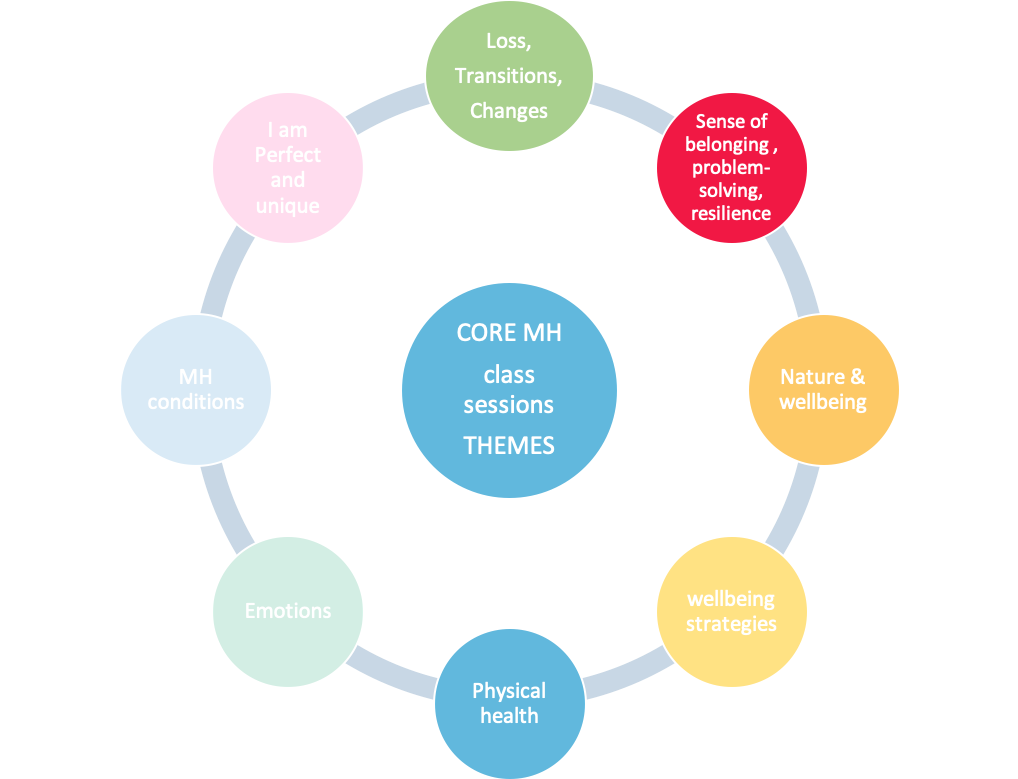
- Focused on a number of different themes which all contribute to building resilience and strength,
- Structured into a hook (image, video or audio note), discussion, engaging task and take-away message or practical strategy.
- Impactful and measured using surveys and meaningful assessments…all aligned to Ofsted requirements in Personal Development & Wellbeing.